
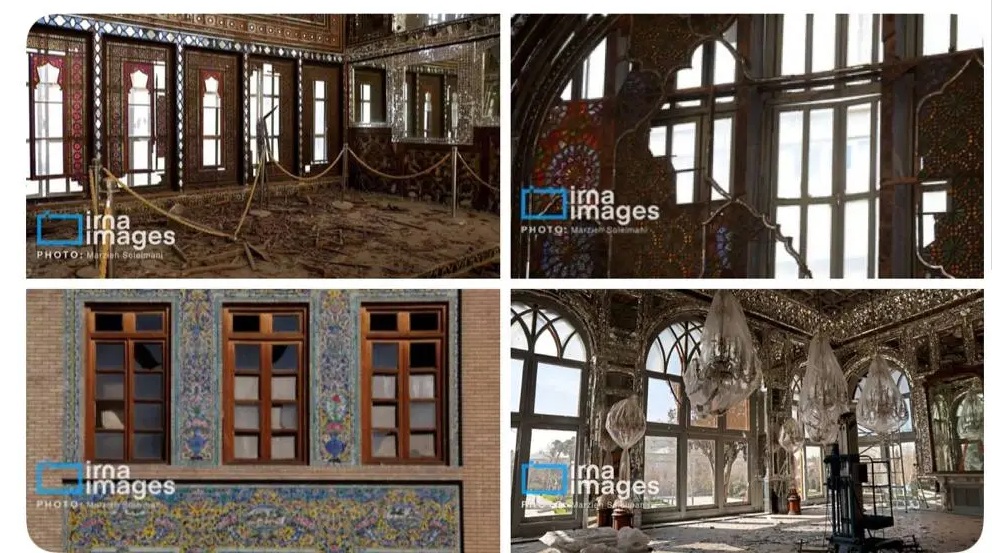
During the military aggression by the United States and the Israeli regime, which began in February 28, 2026 with the violation of the fundamental principles of the United Nations Charter, alongside the targeting of numerous military centers, especially schools, hospitals, residential areas, stadiums, public service centers, bridges, and roads, the world is witnessing a series of attacks on Iran’s historical monuments and cultural property. According to a report by Iran’s Ministry of Cultural Heritage, Tourism and Handicrafts, within approximately the first ten days of the “Ramadan War,” at least 56 museums, historical monuments, and cultural sites in various provinces of the country have been targeted by the US and the Israeli regime, suffering structural and serious damage. Tehran province tops this list with 19 damaged sites; additionally, 12 prominent monuments in Kurdistan and several historical sites in Isfahan have been damaged. Among the damaged sites in the military aggression by the US and the Israeli regime are the Golestan Palace, the Chehel Sotun Palace-Museum, a part of the historical fabric of central Tehran, mansions such as Asef, Salar Saeed, and Khosrowabad in Sanandaj, the Rashk-e Janan Palace (Governor’s Palace) in Isfahan, and the Anthropology and Archaeology Museum of Falak-ol-Aflak Castle in Khorramabad.
Thus, it appears that the US and the Israeli regime, in addition to committing war crimes by targeting civilians, have deliberately and with specific intent, put attacks on Iran’s historical monuments and cultural property on their agenda. In this regard, seven explanatory points can be made:
First; Most of the 56 historical, cultural, and ancient sites of Iran have been damaged due to attacks carried out by the US and the Israeli regime in areas near these sites. In fact, because a direct and deliberate attack on cultural property constitutes a war crime, the US and the Israeli regime are attempting to damage these historical sites under the pretext of targeting some alleged centers near them. This is while there is no proven military necessity for these crimes; rather, they have been carried out by the US and the Israeli regime with the “specific intent” of completely erasing the symbols of Iranians’ historical, civilizational, national, and religious identity. Even before the Ramadan War, the US and the Israeli regime had shown their desire to destroy Iranians’ cultural property; for instance, after the assassination of Martyr Qasem Soleimani on January 3, 2020 (13 Dey 1398), then-US President Donald Trump threatened: “We have targeted 52 Iranian sites, some of which are of great importance to Iran and Iranian culture.”
Second; Cultural property does not belong solely to nations; it is considered part of the common heritage of humankind. For this reason, since the early development of international law, cultural property has been protected under international law. For the first time, the protection of cultural property was seriously emphasized in the Hague Conventions of 1899 and 1907. According to the 1954 Hague Convention for the Protection of Cultural Property in the Event of Armed Conflict and its two Protocols of 1999, the 1977 Additional Protocol I to the Four Geneva Conventions, the Rome Statute of the International Criminal Court (2002), the 1972 Convention Concerning the Protection of the World Cultural and Natural Heritage, and the principles of customary international law, any deliberate attack by the US and Israel against Iran’s historical sites and cultural heritage constitutes a grave violation of international humanitarian law and a clear example of a war crime, incurring civil and criminal responsibility for the US, the Israeli regime, and their statesmen.
Third; The 1954 Hague Convention for the Protection of Cultural Property in the Event of Armed Conflict and its Second Protocol of 1999 have established a strong legal framework for the protection of cultural property during armed conflicts. This Convention, which entered into force in 1956 and has over 130 states parties, defines the concept of “cultural property,” outlines the duties of states to refrain from targeting cultural property, prepare and declare lists of such property, and mark them with the “Blue Shield” emblem as a symbol of protection for cultural heritage during war. Furthermore, by defining the parameters of military necessity, this Convention and its two Protocols have sought to prevent cultural property from being targeted under the pretext of military necessity and have linked its violation to the concept of war crimes and criminal penalties. In this regard, the Second Protocol to the Hague Convention of 1999 strengthened the framework for the protection of cultural property by establishing provisions on criminal jurisdiction, the obligation to prosecute or extradite, and mutual legal assistance.
Fourth; Consistent with the above point, not only is a direct attack on a historical or cultural monument prohibited, except under exceptional circumstances where cultural property has been turned into a military objective according to the 1954 Hague Convention and principles of international law, but any military action causing indirect damage to cultural property is also not permitted. Unlike Iran, which is a party to the 1954 Hague Convention and its 1999 Second Protocol, the US is not a party to this treaty. This fact does not prevent the realization of civil and criminal responsibility for the US and its statesmen under customary international law. Because the principles of customary international law are binding on all states, and the provisions of the 1954 Hague Convention are derived from these customary rules. A look at the US’s actions in the wars in Vietnam, Yemen, Afghanistan, and Iraq, including the catastrophe at the Baghdad National Museum in 2003 and the destruction or theft of 170,000 historical artifacts there, shows that US administrations have also harbored hostility towards the cultural and civilizational heritage of nations in their attacks. At the same time, the Israeli regime, despite being a party to the 1954 Hague Convention, has shown during the occupation of Palestine and the genocide in Gaza, by targeting hundreds of historical sites belonging to Muslims and Christians in occupied Palestine, that alongside the genocide of the Palestinian population, it is also pursuing their cultural genocide, and it has now adopted the same practice against Iran.
Fifth; From the provisions of the set of binding international legal documents and rules concerning deliberate military attacks on cultural property, it is clear that such attacks constitute war crimes, for which the perpetrators and those who order them must face criminal punishment. Since the cultural property of nations is in a way a heritage belonging to all humanity, all states have a responsibility to protect them. Alongside states, the United Nations, UNESCO, the International Council of Museums (ICOM), the global Blue Shield network, the International Committee of the Red Cross, and the International Criminal Court have responsibilities in this regard. Although over 120 cultural properties, some of which are registered as World Heritage, have been marked by Iran with the “Blue Shield” emblem, and their list has been previously available to UNESCO, the performance of UNESCO and the Intergovernmental Committee for the Protection of Cultural Property in the Event of Armed Conflict (under the 1954 Hague Convention) in this regard has so far not been acceptable. Simply expressing concern by Lazare Eloundou Assomo, Director of the UNESCO World Heritage Centre, about the impact of the war on World Heritage sites is insufficient. Although the US, by withdrawing from UNESCO during the Trump administration – which, according to Article II, paragraph 6 of UNESCO’s Constitution, will take effect on December 31, 2026 – showed that the Trump administration places no value on this organization and global cultural norms, this fact should not prevent decisive action by UNESCO, including condemning the aggression by the US and the Israeli regime against Iran’s cultural property.
Sixth; According to Article 4, paragraph (2) of the Hague Convention for the Protection of Cultural Property in the Event of Armed Conflict, as well as Article 6 of its Second Protocol of 1999, directing military operations against cultural property is permissible only when and for as long as that cultural property has, by its function, been turned into a military objective; and there is no feasible alternative to obtain a similar military advantage to that offered by directing a military operation against that objective. None of the 56 damaged Iranian cultural sites were military objectives, but the US and the Israeli regime, in order to damage them, have attacked alleged targets in areas near these cultural properties. In fact, their “specific intent” and “main objective” was to damage these cultural properties under the pretext of targeting alleged nearby objectives. The US and the Israeli regime, alongside destroying strategic infrastructure, and driven by malice towards Iran’s seven-thousand-year history, have undertaken deliberate attacks on cultural property, which constitute an example of “cultural genocide” and a “war crime.”
Seventh; Cultural, historical, and civilizational property constitute the tangible part of nations’ history. Cultural heritage is the link that connects a nation’s identity to its historical geographical territory. The destruction of a historical and civilizational monument is an attempt to sever a nation’s connection with its identity symbols. The goal of the cultural genocide by the US and the Israeli regime is to erase Iran’s cultural heritage, this cradle of seven thousand years of history and civilization. Iran’s ancient civilization and the religious and national values of this ancient land, from the teachings of Cyrus the Great to the principles of the liberating school of Shiism, combining together, have created a strong fortress against enemy aggression and fostered a spirit of “historical resistance” in Iranians. Even today, some of Iran’s dependent neighbors, whose history barely spans five hundred years, look with envy upon Iran’s seven-thousand-year history, and by comically falsifying their own history, speak of their own multi-thousand-year historical wisdom?! In order to carry out the “Greater Israel” conspiracy, America and the Israeli regime need to divide Islamic countries in West Asia, from Saudi Arabia and Kuwait to Jordan and Iraq. Iran stands as a firm barrier against this fragmentation plot. Therefore, they seek to destroy “historical Iran” and the “united and historical Iranian nation” through various means such as inciting ethnic groups and arming terrorist and separatist groups; the attacks on the cultural, civilizational, and religious property of Iranians are also part of this strategy to fragment Iran by Washington and Tel Aviv; but the seven-thousand-year history shows that the aggressors have been humiliated and gone, while a proud Iran remains.
* Dr. Ahmad Kazemi, Professor of International Law at the University


Leave A Comment