
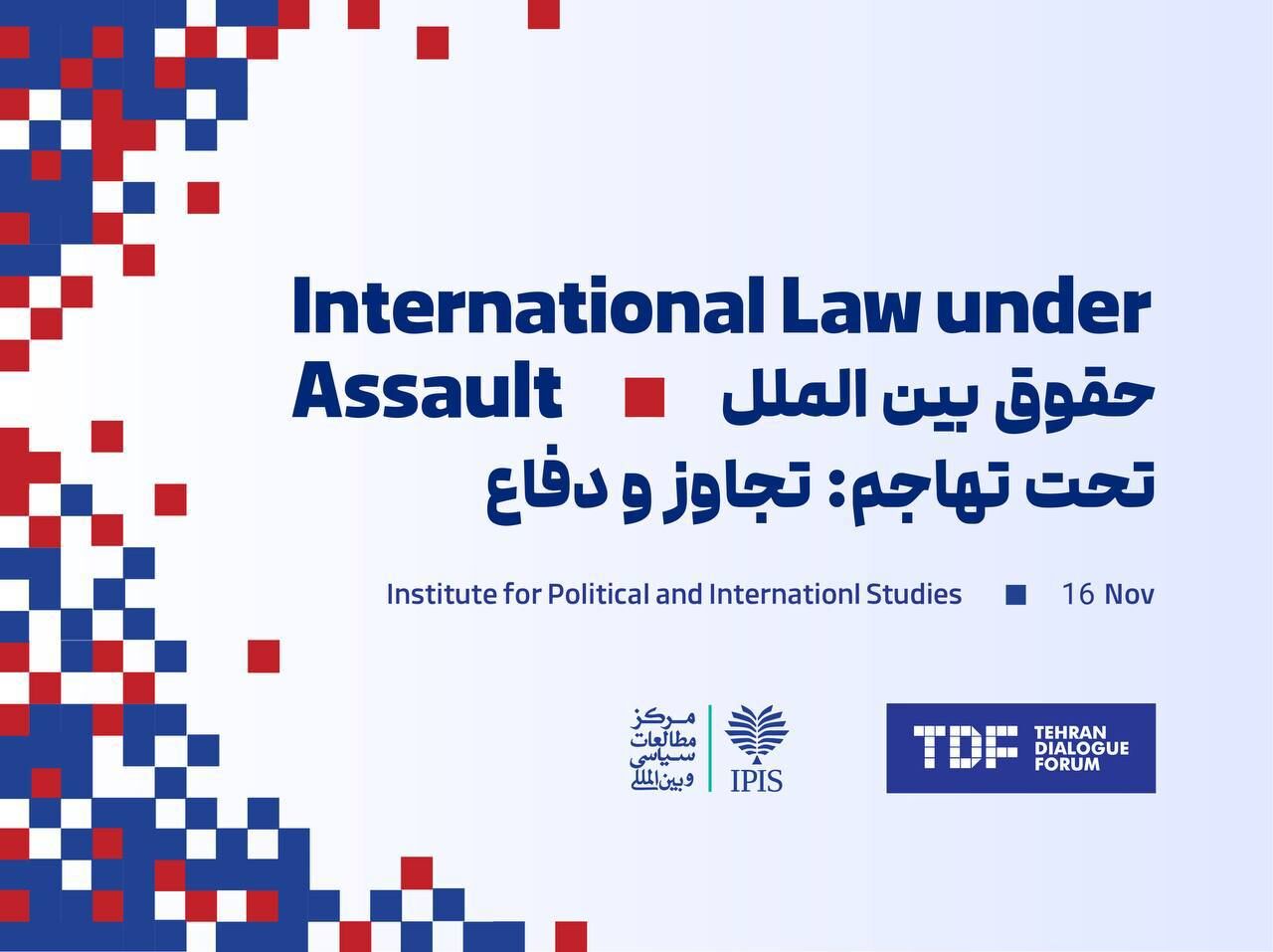
The holding of the international conference “International Law Under Assault: Aggression and Defense” in Tehran with four axes: “International Law Under Siege: From a Law-Based Order to a Rules-Based Order”, “Betrayal of Diplomacy: US and Israeli Aggression against Iran”, “Nuclear Non-Proliferation at Risk: Dominant Trends and Discourses” and “Reviewing Regional Security Arrangements: Key Elements and Determinants”, once again brought into focus the issue of the decline of the traditional international legal order and the necessity of establishing a new legal order centered on empowering its enforcement guarantee.
If we consider the main pillars of international law to be the five pillars of international human rights law, international humanitarian law, criminal law, environmental law and trade law, the developments of the last seven decades, especially the developments of the past years, show that the international legal order resulting from the UN Charter is severely weakening and deteriorating.
International human rights, which sought peace, equality and international justice for all human beings and non-discrimination with the Universal Declaration of Human Rights (the three documents of the 1948 Declaration and the 1966 Covenants), are now in their weakest state due to double standards, especially in the field of human rights and terrorism, the transformation of cruel sanctions into a tool of political coercion to change the behavior of independent actors in the foreign policy of some major powers, the gap between the global North and South, and the continuation of systematic racial discrimination in some Western countries, especially the United States and the United Kingdom. Genocide, violations of the right to exist and the cultural, religious and linguistic rights of minorities in Myanmar, Sudan, the Caucasus, Ukraine, India, Pakistan, Saudi Arabia, Turkey and many other countries have shown that despite the existence of progressive human rights documents, including the 1992 UN Declaration on the Rights of Persons Belonging to Religious, Ethnic, Linguistic and National Minorities, they lack enforcement guarantees.
International humanitarian law is one of the most important pillars of the post-war international legal order, but the highest number of violations of obligations by international subjects is seen in this area. In the last five years, five events, including the 12-day military aggression by Israel and the United States against Iran and the failure of the safeguards system to protect Iran’s peaceful nuclear facilities, the war in Ukraine, the genocide of Palestinians in Gaza after October 2023 and the aggression against Lebanon, and the tragic incidents in Sudan and Venezuela, have shown that the foundations of international humanitarian law, both the Hague Rules and the Geneva Rules, especially the Four Geneva Conventions (1949) and their Additional Protocols, are being undermined. In fact, due to the hostage-taking of humanitarian law by the Security Council, whose actions violate the Charter and ideals of the United Nations, international humanitarian law and the United Nations have been unable to stop military aggression, aggressive war, counter terrorist acts, genocide through the most inhumane methods such as starvation and starvation, destruction of hospitals and killing of children.
International criminal law After the ratification of the Rome Statute and the establishment of the International Criminal Court in 2002, long-standing hopes for “combating impunity” in international law increased, but on the one hand; the great powers, which often have several criminal cases affected by their war-making policies, used the issue of immunity as a tool to prevent the Court from extending its criminal jurisdiction to rebel and apartheid regimes. On the other hand, despite some criminal cases investigating crimes committed by a number of statesmen who committed international crimes, this issue has mainly focused on African cases, and many of the court’s rulings, including the immediate arrest warrant for the Israeli Prime Minister and Minister of War, have not yet been implemented due to the unilateral and unjust actions of the United States and the United Kingdom.
International environmental law, despite the fact that after the Stockholm and Rio Declarations in 1972 and 1992, it was able to incorporate some principles of environmental law, such as the principle of common but differentiated responsibility, the principle of prohibition of harmful use of the environment, the polluter pays principle, the precautionary principle and timely information into the customary rules of international law; however, it has the weakest scope of enforcement guarantee among the various branches of international law. Because many major powers refused to accept their commitments, including to reduce global warming and preserve the ozone layer, stopped oil pollution of the seas and adopted “pollution trading,” opposed the criminalization of environmental crimes in international law, and refused to join the binding convention on international environmental law.
In the field of international trade law, the performance of the World Bank and the International Monetary Fund showed the unilateral hegemony of the dollar over international trade after the Bretton Woods Conference. The instrumental use of the dollar by the US to pressure and intensify sanctions on countries critical of or opposed to the US has led to the establishment of blocs such as Shanghai and BRICS in order to de-dollarize the international system by strengthening the idea of establishing a union of countries under sanctions.
The current weak state of international law has strengthened the view of critics of international law more than ever before, who believe that this field is not law (binding rules), but a set of moral norms that lack enforcement guarantees. The decline of the international legal order shows that liberal culture and the Western order are unable to comprehensively respond to the human needs and human rights of the international community; therefore, a new legal order needs to be established in this regard. The pioneers of this process should be countries whose history has repeatedly confirmed their pacifism, altruism, justice-building, and anti-aggression.
Ancient Iran, with its two pillars of human rights, can be a pioneer or activist in designing a new legal order with the support of other independent, revisionist, and aligned actors:
The first pillar is the progressive history of Iranian human rights, which is rooted in the ancient history of Iran and in the 2,500-year-old charter of Cyrus the Great.
The second pillar is rooted in the Islamic and Shiite culture of this land, which is rooted in the legal teachings of authentic Islam as well as the pure thoughts of Imam Ali (AS); an Imam who, according to Christian George Jurdaq, is the “voice of human justice” whose model of “just governance” is evident in his Nahjul-Balagha.
The holding of the Tehran Dialogue Forum and the conference “International Law Under Assault: Aggression and Defense” by the Office of International Studies of the Ministry of Foreign Affairs from this perspective, as well as the deliberations of legal scholars and international relations elites, about the legacy of ancient civilizations and actors with common and aligned interests, are important for the formation of a new legal order.
*Dr. Ahmad Kazemi, Professor of International Law at the University of Tehran




Leave A Comment